Telephone modem, note add there are swiss 4-pin telephone plugs.
Computing and computers
260 Archival description results for Computing and computers
A logic analyzer is an electronic instrument that captures and displays multiple signals from a digital system or digital circuit. A logic analyzer may convert the captured data into timing diagrams, protocol decodes, state machine traces, assembly language, or may correlate assembly with source-level software. Logic Analyzers have advanced triggering capabilities, and are useful when a user needs to see the timing relationships between many signals in a digital system.
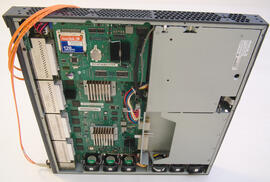
It's a 48 x 1 Gbit/s port switch with 10 Gbit/s optical uplink connection.
The Power Macintosh 7300 was released in 1997 and was the same case as the Power Macintosh 7600. Its main evolution is that it was equipped with a faster processor. It also had a bigger hard drive (2 GB) and a faster CD-ROM drive (12x to 8x). In return, Apple chose to remove the audiovisual connections that were present on all its predecessors of the range 7x00.
It has a storage capacity of 40 Mb.
A new generation with a reworked motherboard is launched on 2001 with however the same Graphite box. It also included a processor speed-bump, and brought the DVD-R "SuperDrive" to the mid-level model. The Quicksilver PowerMac was available in three configurations: The 733 MHz model, with 128 MB of RAM, a 40 GB hard drive, and a CD-RW drive, was 1,699 dollars, the 867 MHz configuration, with 128 MB of RAM, a 60 GB hard drive and a DVD-R drive, was 2,499 dollars, and the high-end dual-800 MHz model, with 256 MB of RAM, an 80 GB hard drive and a DVD-R drive, was 3,499 dollars. The 733 MHz model is the first personal computer to have a DVD burner, named SuperDrive at Apple. The design was updated on 2002 with 800 MHz, 933 MHz and dual 1 GHz configurations, becoming the first Mac to reach 1 GHz.