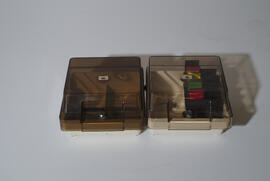
The CDC 6600 cordwood module containing 64 silicon transistors. The module was mounted between two plates that were cooled conductive by a refrigeration unit via the front panel. The construction of this module uses the cord method, so called because the resistors seem to be stacked like cord between the two circuit boards in order to obtain a high density. The 6600 model contained nearly 6,000 such modules.
Computing and computers
129 Archival description results for Computing and computers
It's a timing disc from the CDC 3300 computer. This computer was released in 1965. Moreover CDC means Control Data Corporation.
Capacity of this cable : 15 MVA / 13,5 MW / 450 Ampères.
Control units were connected to the channels with "Bus and Tag" cable pairs. The bus cables carried the address and data information and the tag cables identified what data was on the bus. There were three general types of bus-and-tag cables produced by IBM.
A modern 2.8TB/s router, the backbone of our internet connectivity. This model was in service at CERN from 2008 until 2012.
In the late 70s the larger IBM computers were water cooled. Amdahl, an IBM competitor, invented an air cooling technology for it's computers. His company worked hard, developing a computer that was faster and less expensive than the IBM System/360 mainframe computer systems. This object contains an actual Amdahl series 470 computer logic chip with an air cooling device mounted on top. The package leads and cooling tower are gold-plated.
The AM29116 is a microprogrammed 16-bit processor.
It's an acoustic coupler modem 300 bit/s from the 1970s. It is attaches to an ordinary telephone handset.
A diode matrix is an extremely low-density form of read-only memory. It's one of the earliest forms of ROMs (dating back to the 1950s). Each bit in the ROM is represented by the presence or absence of one diode. The ROM is easily user-writable using a soldering iron and pair of wire cutters.This diode matrix board is a floppy disk boot ROM for a PDP-11, and consists of 32 16-bit words. When you access an address on the ROM, the circuit returns the represented data from that address.
The 8-inch floppy disk was a magnetic storage disk for the data introduced commercially by IBM in 1971. It was designed by an IBM team as an inexpensive way to load data into the IBM System / 370. Plus it was a read-only bare disk containing 80 KB of data. The first read-write version was introduced in 1972 by Memorex and could contain 175 KB on 50 tracks (with 8 sectors per track). Other improvements have led to various coatings and increased capacities. Finally, it was surpassed by the mini diskette of 5.25 inches introduced in 1976.