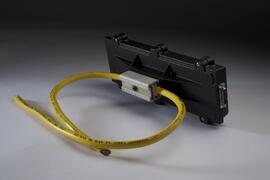
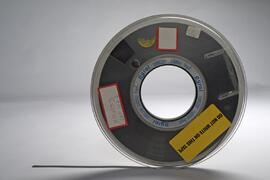
The 8mm backup format is a format for storing magnetic tape data used in computer systems, launched by Exabyte Corporation. It is also known as Data8, often abbreviated to D8 and writes D-Eight on some Sony brand media. The company was formed in order to take the 8 mm video format and make it suitable for data storage. They did this by building a mechanism and a reliable data format that used the common 8 mm video tape technology that was available at the time. This was the first form of helical scanning used commercially for data storage. The ribbon was made vertically and has a length of 112 meters. It was designed to withstand heat and high temperatures. It has been introduced in at CERN in 1994.
Computing and computers
130 Descrição arquivística resultados para Computing and computers
Physicists coded and recorded their programs through series of holes on punch paper tape or on punched cards. It was popular in the 1970s due to its high throughput speed and low cost, paper tape was one of the original data storage methods for computers. Information was encoded in the distinct pattern of holes punched in the paper; the paper itself was oiled to facilitate being run through the reading mechanism and to prevent tears due to brittleness. Though the paper was cheap, it had low storage capacity (only a few dozen kilobytes per roll) and the machinery involved in punching the holes was quite expensive. Higher capacity alternatives, such as magnetic tape, has get developped.
It's a 250 MB External Zip Disk Drive Portable
This is a Thermal Conduction Module from an IBM 3090. This is a water cooled unit that holds loads of chips.
The M6-640 is the highest performance personal computer workstation in the Suprema range with multimedia, document imaging and communications capabilities. It has a 90MHz Pentium processor with 256Kb of secondary cache. It can accommodate up to 128Mb RAM and supports hard disks of up to 1Gb through an IDE interface.
Disk Interface for a disk cabinet.
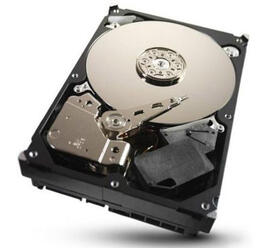
It's a disque PC IDE 850 Mbytes.
It has a storage capacity of 200 Mb.
A diode matrix is an extremely low-density form of read-only memory. It's one of the earliest forms of ROMs (dating back to the 1950s). Each bit in the ROM is represented by the presence or absence of one diode. The ROM is easily user-writable using a soldering iron and pair of wire cutters.This diode matrix board is a floppy disk boot ROM for a PDP-11, and consists of 32 16-bit words. When you access an address on the ROM, the circuit returns the represented data from that address.