
Identity area
Reference code
Title
Date(s)
- 1900-1958 (Creation)
Level of description
Extent and medium
5 linear metres + Salle Pauli
Context area
Name of creator
Biographical history
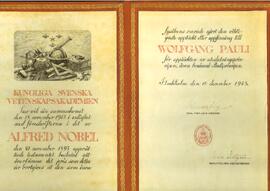
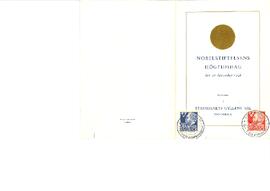
Wolfgang Ernst Friedrich Pauli was born in Vienna on the 25th April 1900, the son of Wolfgang Joseph Pauli, a medical doctor, and of Bertha Schütz. Pauli was soon intellectually influenced by his father, also a distinguished professor of colloid chemistry and his godfather Ernst Mach, a physicist. Pauli went to the University of Munich in 1918 and studied theoretical physics under Arnold Sommerfeld. According to the University rules, Pauli had to attend a three year course before being admitted to the doctoral examinations. As he already had an excellent command of physics, Sommerfeld entrusted him with writing an article on relativity theory for the Mathematical Encyclopedia. His 200-page article (published in 1921), consisting of the most current work on relativity and some of his own interpretations, was praised by Einstein in public. In 1921 Pauli obtained his doctorate. In the winter term, from 1921 to 1922, Pauli worked as Max Born's assistant at Göttingen University, then he went on to be an assistant of Wilhelm Lenz at Hamburg University. After one year's leave at Niels Bohr's Institute at Copenhagen, in 1924, Pauli's research and interest in the anomalous Zeeman effect culminated in the formulation of the "Exclusion principle" which rules how particles like electrons are distributed in the atom. For this he received the Nobel Prize in 1945. From 1924 to 1928, Pauli was honorary professor at the University of Hamburg. Then, in April 1928, he became Professor at the Eidgenössische Technische Hochschule (ETH) in Zurich. He kept this professorship until his death. In July 1940, Pauli and his wife Franca had to leave Europe because of the war. At the Institute for Advanced Study at Princeton, in New Jersey, he could pursue his work on mesons and cosmic ray physics as a visiting professor. In November 1945, while still at Princeton, he received the news that he had been awarded the Nobel Prize for his "Exclusion principle". It was not until December 1946 that he was able to travel to Stockholm and deliver his Nobel lecture. Pauli obtained American citizenship in January 1946, but he returned to Zürich in the same year to take back his professorship at the ETH. After many years waiting, Pauli became a Swiss citizen on the 15th July 1949. Pauli's theoretical prediction, in 1930, of the existence of the neutrino, was finally borne out by its detection by Clyde Cowan and Fred Reines at Los Alamos in 1956. On the 15th December 1958, at the age of 58, Pauli died of cancer at the Red Cross Hospital in Zürich.
Repository
Archival history
After Pauli's death in 1958, Mrs. Franca Pauli, his widow, assisted by Pauli's last assistant, Charles Enz, started to sort and administer Wolfgang Pauli's scientific legacy. The collection mostly contained only letters Pauli had received, but not those he had sent. Franca Pauli, with Victor F. Weisskopf (one of Pauli's former assistants and Director-General of CERN from 1961 to 1965) and Ralph de Laer Kronig, sent out a circular letter inviting friends and colleagues of Wolfgang Pauli to send their copies or originals of his imposing correspondence. Niels Bohr and R. Oppenheimer from Princeton supported the whole operation. On the 25th August 1960 Mrs. Pauli made a first Deed of Gift of part of her late husband's estate to CERN, represented by the Director-General In 1965, Weisskopf's mandate as Director-General of CERN came to an end and he returned to the Massachusetts Institute of Technology (MIT). He continued to be an advisor to Mrs. Pauli. The new Director-General, Bernard P. Gregory, became the first ex-officio member of the Pauli Committee, created in 1965. A mandate to look after the collection was entrusted to Alfred Günther, who was at that time the head of the Scientific Information Service. Mrs. Pauli made a second Deed of Gift on the 5th November 1971. After Mrs. Pauli's death in 1987, CERN inherited all author rights for the scientific work of Wolfgang Pauli.
Immediate source of acquisition or transfer
Pauli's widow, Mrs. Franca Paul, donated most of the collection. Other material has been collected on behalf of the Pauli Committee, much of it by Karl von Meÿenn. Copies (PDF) of the notes taken by Josef Jauch, while a student at the ETH (Eidgenössische Technische Hochschule) Zürich, of Wolfgang Pauli's lectures were added in 2015. They are part of the Jauch Archive, held at the Department of Theoretical Physics, University of Geneva, and are reproduced by courtesy of the University.
Content and structure area
Scope and content
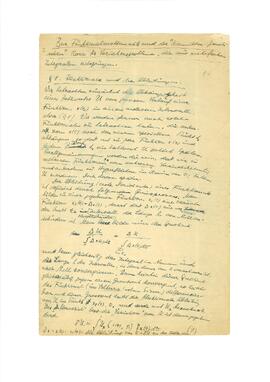
The Pauli Archive is a collection of the scientific books, reports, reprints, correspondence and manuscripts of the Nobel Prize-winning physicist, Wolfgang Pauli (1900-1958). The collection contains some photographs and various personal items such as his awards and the baptismal cup given to him by his godfather Ernst Mach. Subjects discussed include physics and wider philosophical, psychological and epistemological issues.
Appraisal, destruction and scheduling
Nothing was destroyed.
Accruals
A few further items may be collected.
System of arrangement
The fonds of the Pauli Archive are organised in different series.
- The Pauli Letter Collection (PLC)
- The Pauli Manuscript Collection (PMC)
- The Pauli Biographical Collection (PBC)
- The Pauli Photo Collection
- The Salle Pauli Collection (Pauli's library, includes his books on scientific and other subjects, and his large reprint collection)
- The Pauli Object Collection (includes baptismal cup, Nobel prize, ...)
Miscellaneous material (not yet catalogued, includes copy of letters held at ETH Zurich Archive)
Conditions of access and use area
Conditions governing access
See file level description and the CERN operational circular No 3: rules applicable to archival material and archiving at CERN. In general, records on any subject that are over 30 years old, and all records of a purely scientific nature, may be consulted.
Conditions governing reproduction
Copyright is retained by CERN, no reproduction without permission.
Language of material
German
English
Script of material
Language and script notes
Most of the material is written in German and English. The Pauli Archive also contains documents in Dutch, French, Italian and Russian.
Physical characteristics and technical requirements
Finding aids
Allied materials area
Existence and location of originals
Existence and location of copies
Related units of description
Notes area
Alternative identifier(s)
Access points
Subject access points
Place access points
Name access points
Genre access points
Description control area
Description identifier
Institution identifier
Rules and/or conventions used
Level of detail
Dates of creation revision deletion
Language(s)
Script(s)
Sources
Archivist's note
Description prepared by Kieran Pavel. Date(s) of description: Geneva, May 2001.